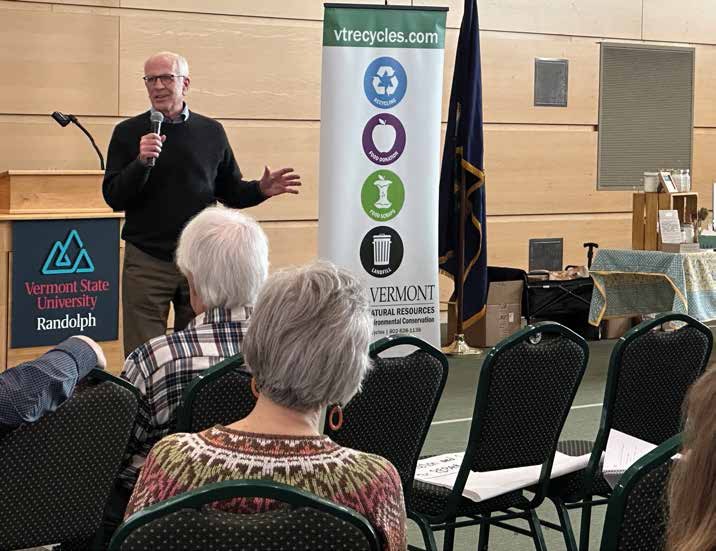
U.S. Sen. Peter Welch visited Vermont State University’s Randolph Center campus last Thursday to push federal legislation that would let farmers repair their own equipment without calling a dealer.
Welch appeared at ReuseVT’s inaugural ReuseApalooza conference, a day-long gathering that mixed a repair fair, a “drop and swap” event, and workshops on waste reduction. He opened with a detour about his own thrift habits, telling the crowd he shops for used clothes online. “I’m not kidding, you get good deals,” he said. Then he got to the harder economics facing Vermont farmers.
The legislation he championed is the Freedom for Agricultural Repair and Maintenance Act, known as the FARM Act, which Welch introduced last October. The bill would require manufacturers to share software, parts, and documentation with farmers and independent repair technicians. Right now, Welch said, a farmer who drops several hundred thousand dollars on a tractor has almost no recourse when something breaks. “They have to call the dealer. They have to wait till the repair [person] comes out, and they have to have it repaired on site, and that costs some time. It could be a harvest season, and honestly cost a lot of money.”
The timing of his visit was sharp. Just days before the conference, it was widely reported that John Deere agreed to pay $99 million to farms and farmers as part of a class action settlement over allegations the company monopolized repair services. A separate lawsuit, brought by the Federal Trade Commission in 2025, alleges Deere forces farmers toward its own dealers and inflates costs for parts and labor. Welch didn’t miss the irony.
Farmers, he said, are “really good” at “fixing things.”
The FARM Act fits into a broader right-to-repair push that’s been building at state and federal levels for years. Vermont’s own efforts have had a rough road. A state bill, H.81, passed the House with near-unanimous support before dying in the Senate in 2024. Lawmakers have now revived the idea through H.161, the Vermont Fair Repair Act, introduced last year and co-sponsored by state Rep. Monique Priestley, D-Bradford.
Priestley, as reported by VTDigger, said the principle is simple: “Vermonters shouldn’t have to ask a corporation’s permission to fix what they own.”
She’s also sponsoring H.160, a separate bill that would extend repair rights to medical equipment, including hospital diagnostic devices. The scope matters. Right-to-repair advocates argue that the same logic that applies to a broken tractor applies to a broken MRI machine, and that locking repair access behind manufacturer gates raises costs and creates dangerous delays in healthcare settings. Vermont’s medical device repair market isn’t large, but the Upper Valley’s proximity to Dartmouth Health and DHMC makes the question locally relevant.
What connects the FARM Act, H.161, and H.160 is a single premise: people who own something should be able to fix it, or hire someone outside the manufacturer’s network to fix it. The current system, critics say, treats ownership as conditional.
Welch’s appearance at ReuseApalooza was a natural fit for that argument. The conference wasn’t a policy event in the traditional sense. It was a room full of people who already buy secondhand, already fix what breaks, and already distrust the throwaway economy. Welch worked that room, but the policy he described would have consequences well beyond it, reaching into machine sheds across Vermont’s farming counties where a broken planter in May isn’t an inconvenience but a financial emergency.
The FARM Act has not yet cleared committee in the Senate. H.161 is still moving through the Vermont Legislature. Whether either bill reaches a floor vote this session will depend on pressure from the same farmers Welch was describing Thursday, the ones standing in a field waiting for a dealer who might not show up until after the crop window closes.
Written by
Dartmouth Independent StaffContributing writer at The Dartmouth Independent
View all articles →