Burlington’s interim police chief turned down a restorative justice offer last week, blocking a formal dialogue between officers and six protesters arrested during an ICE operation in March.
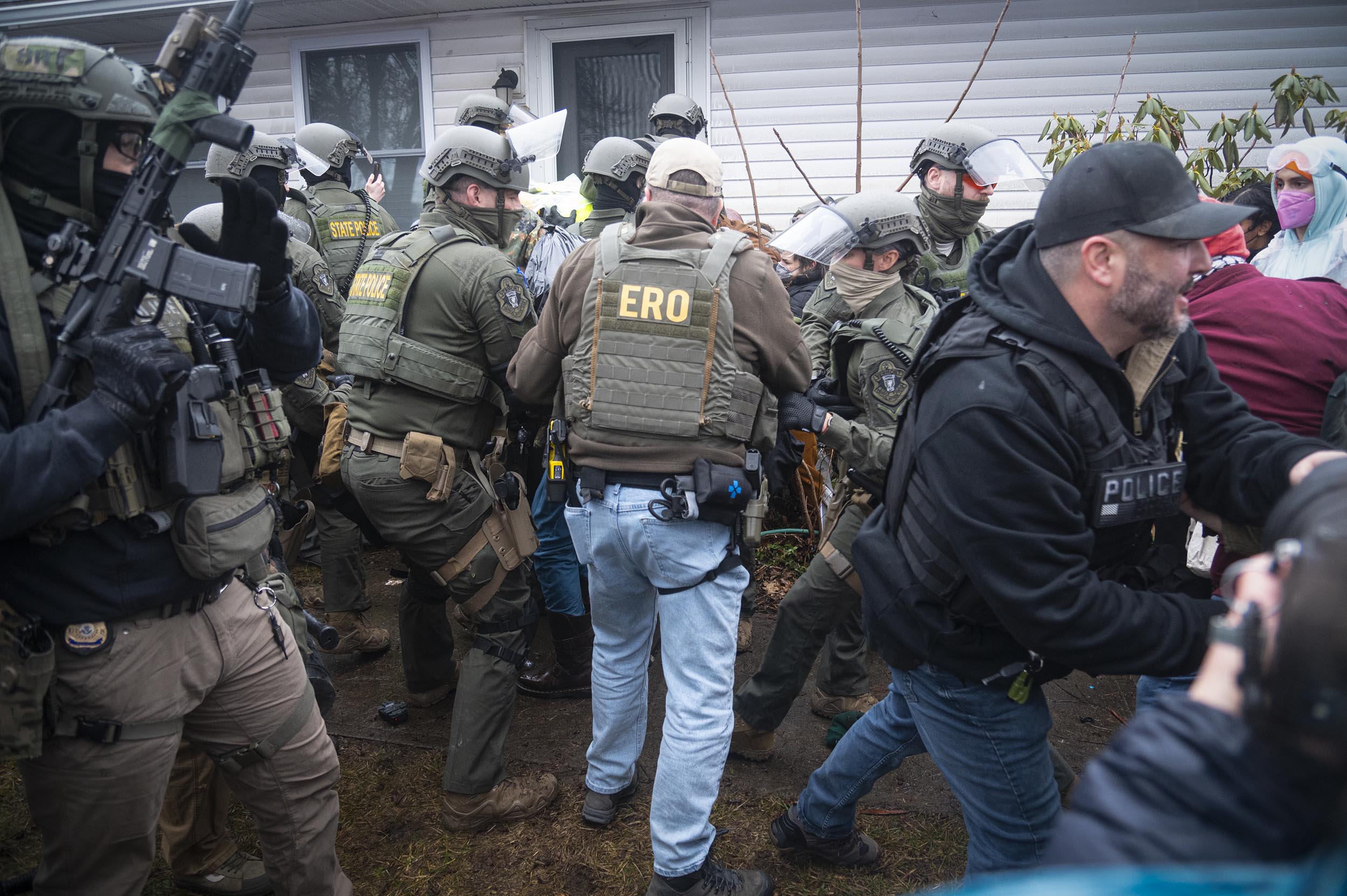
On March 11, state and municipal police arrested six people on South Burlington’s Dorset Street while they tried to stop what the author describes as the illegal abduction of a family by U.S. Immigration and Customs Enforcement. The charges were disorderly conduct. For several of those arrested, the basis was thin. One arrest came because the person stood within arm’s reach of an officer.
State’s Attorney Sarah George reviewed body camera footage and declined to press charges against three of the protesters arrested by state police. The other three, taken in by Burlington municipal police, were diverted to the Burlington Community Justice Center’s restorative justice program. George concluded that both sides shared responsibility for how the confrontation escalated, and asked all six protesters and the police agencies involved to sit down together.
The Burlington Police Department said no.
Interim Chief Shawn Burke wrote Wednesday that the department won’t participate, saying “the rule of law must be upheld.” The Burlington Police Officers’ Association followed with a statement claiming George’s decision “emboldens … disorderly, at times violent, and unlawful civic unrest.”
VTDigger covered the story through the lens of Robert Langellier, one of the six arrested, who is also a wildland firefighter and freelance journalist whose work has appeared in New York Times Opinion, The Atlantic, and Esquire. Langellier said he found George’s restorative justice proposal “inspiring, with the potential for real understanding across a vast philosophical gulf.”
He didn’t get that chance.
Langellier’s account raises questions that extend well beyond Burlington city limits. Dartmouth students and Upper Valley residents who have watched debates over police accountability and restorative justice practices grow sharper since 2020 will recognize the dynamic: a formal mechanism for dialogue exists, the process is offered, and the institution with the most structural power declines to show up.
The BPOA’s statement is the only public communication Burlington officers offered in place of that conversation. Langellier said the statement “sounds more like a child upset at being scolded for fighting with their brother” than a genuine accounting of what happened on Dorset Street. That’s a pointed critique, and it’s one the department hasn’t answered.
Restorative justice programs, including the Burlington Community Justice Center, are built on a straightforward premise: the people most directly affected by a conflict, on all sides, have a right to speak and be heard before an outcome is imposed. The process doesn’t require anyone to admit wrongdoing upfront. It requires presence. Burlington’s officers wouldn’t provide even that.
What’s left is a public record that doesn’t flatter the department. George, an elected state’s attorney, reviewed video evidence and found shared fault. She designed a process that gave officers a path to shape the public narrative about March 11 on their own terms, in a controlled setting, without a courtroom or cameras. They turned it down and issued a press statement instead.
For Langellier and the other five people arrested, the criminal exposure is now resolved or diverted. But the underlying conflict, between a police force that treats physical proximity to an officer as probable cause and a community that believes ICE enforcement in their streets demands a response, won’t be resolved by a BPOA press release. George’s offer was a rare attempt to get both sides into the same room under neutral conditions. Burke’s department declined, and the moment has passed.
The six protesters will go through the Community Justice Center without the officers who arrested them. Burlington police will continue without hearing directly from the people they took into custody. Both groups will return to the same streets in Chittenden County where, on the next contested day, the only space they share will again be a conflict space.
Written by
Dartmouth Independent StaffContributing writer at The Dartmouth Independent
View all articles →