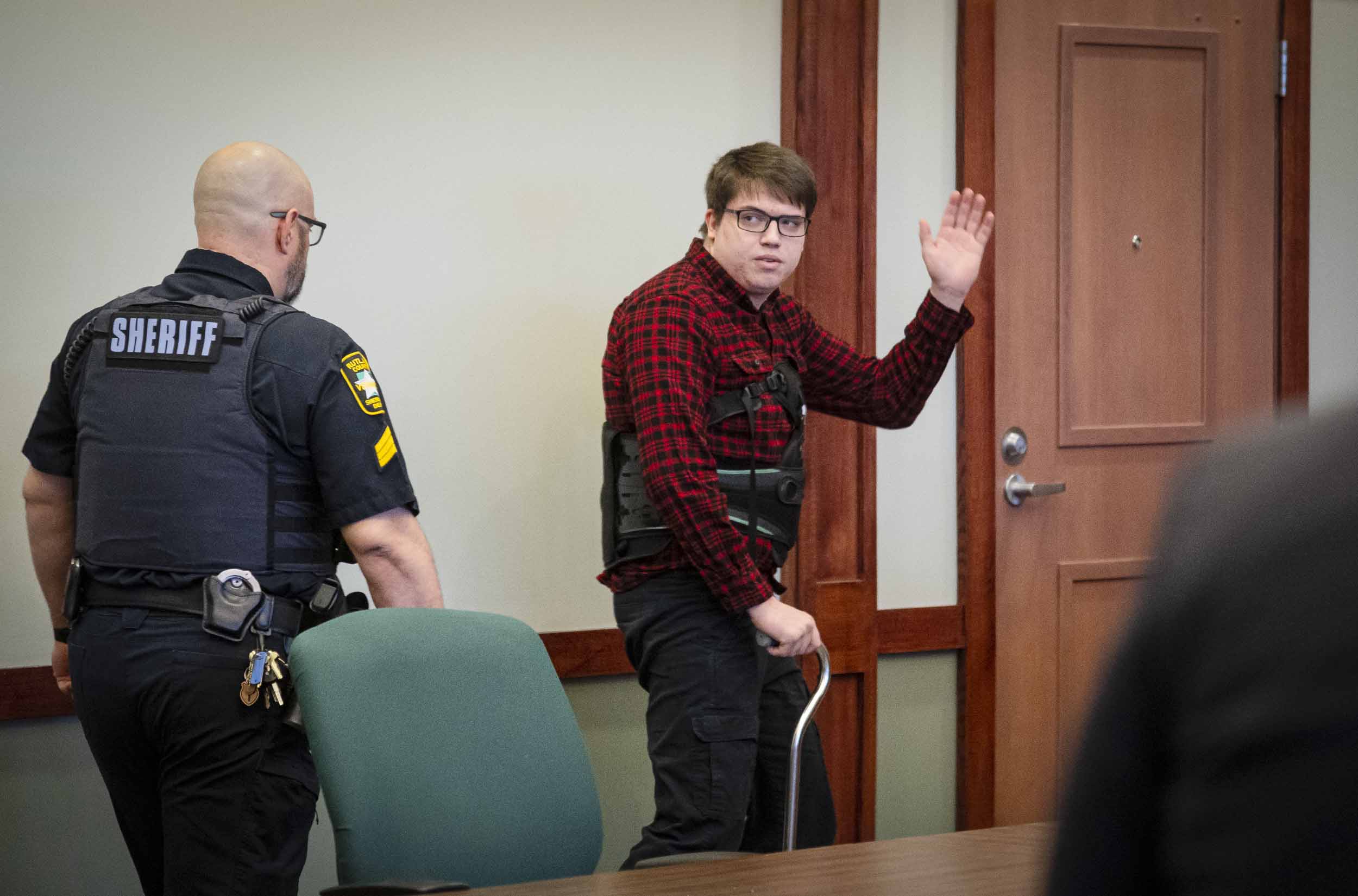
A Vermont defense attorney filed motions this week to toss the aggravated murder charge against the driver accused of killing a Rutland police officer during a high-speed chase in July 2023.
David Sleigh, representing Tate Rheaume, argues that an internal affairs report from the Rutland City Police Department undermines the legal foundation of the state’s most serious charge against his client. That report, which became public last year, found that the pursuit leading to Officer Jessica Ebbighausen’s death violated departmental policy and should never have started.
Ebbighausen was 19 years old.
The chase ended on Woodstock Avenue in Rutland when Rheaume drove his pickup nearly head-on into the cruiser Ebbighausen was driving. She died as a result of the collision. Rheaume, formerly of Salisbury, has pleaded not guilty to several charges, including aggravated murder, which carries a penalty of life in prison without parole in Vermont. He’s currently held without bail awaiting trial.
Sleigh’s argument rests on what the internal affairs investigation concluded after the crash: not just that a policy violation occurred, but that supervisors hadn’t authorized the chase and that officers involved lacked required training. The filing goes further than a procedural complaint.
“The report’s conclusion is not merely that a policy violation occurred. It is that the pursuit should not have started and should have been stopped,” Sleigh wrote in the Rutland County Superior criminal court filing, as reported by VTDigger.
Sleigh told reporters Tuesday that if the motion succeeds, his client would most likely face second-degree murder instead, a charge carrying 20 years to life in prison. The difference matters enormously. Aggravated murder in Vermont is the only offense that can result in a sentence of life without any possibility of parole.
Rutland County State’s Attorney Ian Sullivan filed the aggravated murder charge by citing several factors: that Rheaume “knowingly created” a significant risk of death, that the killing was committed to avoid arrest, and that the victim was a law enforcement officer. Those are the aggravating conditions that Sleigh now wants the court to throw out, arguing the state can’t lean on a police action that its own department later found unauthorized.
“The State cannot transform an unauthorized and dangerous pursuit into the basis for aggravated murder simply because the pursuit ended in a fatal collision,” Sleigh wrote in the filing.
Sleigh also filed separately to move the trial outside Rutland County, citing the substantial publicity the case has received since 2023. Venue changes in high-profile criminal cases are not uncommon in Vermont, where smaller county populations can make seating an impartial jury genuinely difficult. The Vermont Judiciary’s criminal procedure rules allow for venue changes when pretrial publicity may have prejudiced the jury pool.
Ebbighausen’s death drew wide attention across the state. She had been among the youngest officers in the department’s history, and her death prompted both grief and a sharp reexamination of how Rutland City Police handle vehicle pursuits. The internal affairs report, when it became public, added a complicated layer to what had initially read as a straightforward case of a driver fleeing police.
That complexity is exactly what Sleigh is now building his defense around. He’s arguing that law enforcement’s own conduct can’t be used as the legal scaffold for a charge that requires a legitimate law-enforcement predicate. “The legality of the police response matters,” he wrote in the filing. “Where the law-enforcement action was not authorized under departmental policy and was undertaken without the predicate serious offense, the State should not be allowed to rely on that conduct to elevate the charge.”
Under Vermont’s aggravated murder statute, prosecutors must establish specific aggravating factors beyond the killing itself, which is precisely where Sleigh sees his opening. No trial date has been announced for the case in Rutland County Superior criminal court.
Written by
Dartmouth Independent StaffContributing writer at The Dartmouth Independent
View all articles →